EEG tech career guide
How to Become an EEG Technician
An EEG technician records the brain's electrical activity for a physician to read. This guide explains how to become an EEG technician step by step: what the job involves, the requirements, the training and clinical hours, and the ABRET registry exam.
Last updated . Written by EEG Diagnostic Tech.
Step 1: Learn what an EEG technician does
An electroencephalogram (EEG) records the small electrical signals the brain produces, measured in microvolts. The EEG technician, also called an EEG technologist, places the electrodes, records a clean signal and documents the study so a physician can read it.
A typical EEG technician job description includes:
- Patient preparation.
- Measuring the head and placing electrodes with the International 10-20 system.
- Checking impedance and recording routine EEGs.
- Ambulatory EEG setup, long-term and video EEG monitoring.
- Spotting and fixing artifacts, and noting what happened during the recording.
- Documentation, infection prevention, patient safety and patient privacy.
EEG technicians work in hospitals, outpatient clinics, physician offices and neurodiagnostic laboratories.
Step 2: Check the EEG technician requirements
EEG tech requirements depend on two things: the employer you want to work for, and whether you want the registry credential. Employers set their own hiring requirements, so read job postings in your area.
For our program you need no medical or EEG experience, and you must be 18 or older. Chapter 1 starts from zero.
Many clinical sites ask for more before you work with patients. On our Tier 3 application, students are told that sites may require a background check, a drug screen, immunization records and a TB test, BLS certification, a photo ID and HIPAA training.
Step 3: Complete EEG technician training
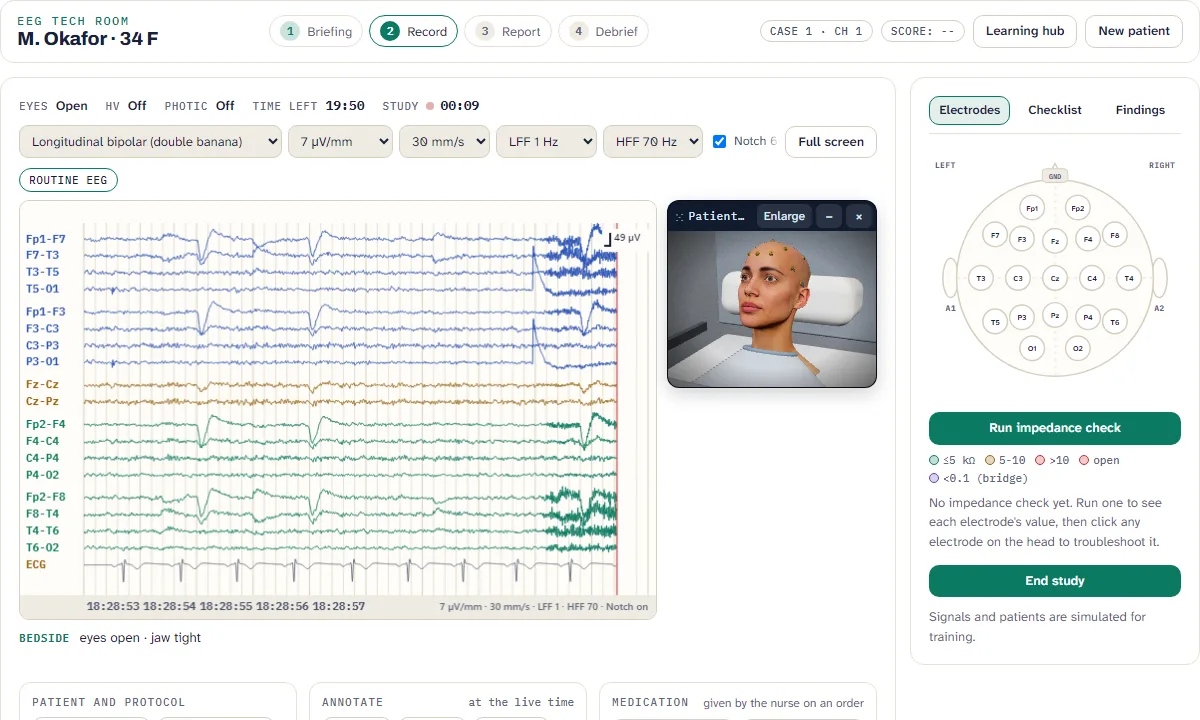
Training covers EEG basics, brain anatomy, the 10-20 system, electrode placement, impedance, montages, artifacts, ambulatory and long-term EEG, and the basics of EEG interpretation. Look for a program with regular tests and hands-on practice.
Our online EEG technician program has six chapters with short lessons, weekly tests, monthly review tests and chapter exams, plus placement games and an EEG simulator for members. You get a certificate of completion after you pass the final exam. You can try the free EEG lesson first, or see EEG program pricing.
Step 4: Get supervised clinical experience
Lessons and simulators teach the skills, but working with real patients needs supervised clinical training. The ABRET pathways also ask you to document a number of EEGs you performed.
In our program, clinicals are part of Tier 3 only: 500 hours of supervised clinical training at a partner clinic in program months 7 to 12, supervised by an experienced EEG lead technologist. You apply for Tier 3 before you pay, and applying is free. Tier 1 and Tier 2 have no clinical hours.
Step 5: Prepare for the ABRET registry exam (R. EEG T.)
The registry credential for EEG technologists is the R. EEG T. (Registered Electroencephalographic Technologist), awarded by ABRET when you pass its EEG exam. ABRET decides who may sit the exam. Its EEG exam page lists four eligibility pathways:
| ABRET pathway | Main requirement | Also needed |
|---|---|---|
| Pathway I | Graduate of a CAAHEP-accredited neurodiagnostic program | Current CPR/BLS; documentation of 50 EEGs |
| Pathway II | Certificate of completion from an ABRET-recognized program that is not CAAHEP-accredited | Current CPR/BLS; documentation of 100 EEGs |
| Pathway III | At least an associate degree, or the RPSGT credential, plus 1 year of clinical EEG experience | Current CPR/BLS; 150 EEGs; a measurement assessment; 60 EEG ASET credits |
| Pathway IV | 5 years of clinical EEG experience | Current CPR/BLS; 150 EEGs; a measurement assessment; 120 EEG ASET credits |
EEG registry exam prep in our program: Chapter 6 covers the paths to ABRET certification, the Your ABRET Path chapter that opens after the final exam walks through eligibility, documents, case logs and exam day, and the Study Hub counts down to the exam date you set. Members can also practice with our EEG simulator and 10-20 placement games, and anyone can try the quiz at the end of the free EEG lesson.
EEG Diagnostic Tech is not affiliated with ABRET or ASET. Finishing our lessons does not make you eligible for an ABRET exam on its own, and it does not replace supervised clinical hours.
Pathways summarized from abret.org in November 2026. ABRET can change its rules; always check ABRET's EEG exam page before you plan around a pathway.
Step 6: Start your EEG tech career
EEG work ranges from routine EEGs to sleep-deprived, ambulatory, long-term video and ICU recordings. Prepare a resume that lists your training, your clinical hours and the procedures you performed, and keep a case log as you go. Our Chapter 6, Career-Ready, covers resume development, interview preparation, ethics and patient confidentiality.
We do not publish salary figures here. As of November 2026 the U.S. Bureau of Labor Statistics has no Occupational Outlook Handbook profile of its own for EEG technologists (see the BLS healthcare occupations list), so there is no official EEG technician salary figure we can cite.
How long does it take to become an EEG tech?
It depends on the training you choose and on the ABRET pathway you follow. Our program takes 6 months on Tier 1 or 12 months on Tier 2 and Tier 3. The ABRET pathways add their own needs: 50 to 150 documented EEGs, and on Pathways III and IV, 1 or 5 years of clinical EEG experience.
EEG technician questions
How do you become an EEG technician?
Learn what the job involves, complete EEG technician training, get supervised clinical experience with real patients, and, if you want the registry credential, meet one of ABRET's eligibility pathways and pass its R. EEG T. exam. The steps above go through each one.
What does an EEG technician do?
An EEG technician (also called an EEG technologist) places electrodes on the scalp, records a clean EEG signal and documents the study so a physician can read it. The work includes patient preparation, routine and ambulatory EEG, monitoring, troubleshooting artifacts and keeping records private.
What are the EEG technician requirements?
Requirements depend on the employer and on the credential you want. To start our program you do not need medical or EEG experience, and you must be 18 or older. For the R. EEG T. registry exam, ABRET lists four eligibility pathways, each with current CPR/BLS and a documented number of EEGs.
How long does it take to become an EEG tech?
There is no single answer. Our program takes 6 months (Tier 1) or 12 months (Tier 2 and Tier 3, with clinicals in months 7 to 12 on Tier 3). The ABRET pathways add their own needs, such as 50 to 150 documented EEGs, and 1 or 5 years of clinical EEG experience on Pathways III and IV.
Can you become an EEG tech without a degree?
Our program does not require a college degree. Of the four ABRET pathways, only Pathway III asks for a degree (at least an associate degree, or the RPSGT credential). The others ask for a qualifying program or 5 years of clinical EEG experience. Employers set their own hiring requirements.
What is the R. EEG T. exam?
The R. EEG T. (Registered Electroencephalographic Technologist) is the registry credential for EEG technologists. ABRET awards it when you pass its EEG exam, and ABRET decides who may sit the exam.
How do I prepare for the ABRET registry exam?
Check ABRET's EEG exam page for your pathway, keep a log of the EEGs you perform, and review with practice questions. In our program, Chapter 6 and the Your ABRET Path chapter cover eligibility, documents, case logs and exam day, and the Study Hub counts down to the exam date you set.
Is EEG Diagnostic Tech affiliated with ABRET?
No. EEG Diagnostic Tech is not affiliated with ABRET or ASET. Finishing our lessons does not make you eligible for an ABRET exam on its own, and it does not replace supervised clinical hours.
More answers on the FAQ page.